
E Tax Invoice: Your Complete Guide to GST Compliance and Digital Billing

Managing tax records accurately is important for businesses handling regular sales and purchase transactions. An e tax invoice provides a digital approach to recording taxable transactions, helping businesses maintain organised financial documentation and simplify GST-related processes.

ADSONZ Business Studio helps businesses understand electronic invoicing requirements and explore suitable digital billing solutions. With the right invoicing system, businesses can improve record management, maintain transaction details and prepare for applicable GST compliance requirements.

 
 
e tax invoice

E Tax Invoice Applicability and GST Compliance


Understand Who Needs to Follow E-Invoicing Requirements

Businesses registered under GST should understand whether their transactions fall within the current e-invoicing framework. The e invoice applicable to whom question depends on annual aggregate turnover, transaction category and specific exemptions under GST regulations.

Check the E-Invoice Applicability Criteria

Before adopting an electronic invoicing process, businesses should check:

  • Whether their aggregate annual turnover exceeds the prescribed ₹5 crore threshold in any preceding financial year from 2017–18 onwards.

  • Whether their business falls under an exempted category.

  • Whether their transactions involve B2B supplies, exports or other covered transactions.

  • Whether their GST registrations under the same PAN affect overall turnover calculations.

Is E Invoice Applicable for B2C Transactions?

A common question is whether e invoice applicable for B2C transactions. Generally, the GST e-invoicing mandate covers specified B2B and export transactions rather than ordinary B2C invoices. However, separate dynamic QR code requirements may apply to certain businesses based on turnover.

Understand the Role of E-Invoicing in VAT Compliance

Businesses should maintain accurate tax calculations and transaction records when implementing digital billing. Understanding e invoicing tax, e invoicing VAT and VAT e invoicing requirements helps organisations distinguish between invoice reporting obligations and applicable tax payment responsibilities.

Check Whether E-Invoicing Is Mandatory for Your Business

The terms e invoice mandatory, mandatory e invoicing and e invoicing compulsory refer to businesses covered by the applicable GST notification. Companies should verify their turnover history, business category and transaction type before determining their compliance obligations.

Stay Prepared for E-Invoicing Phase 2 Requirements

Businesses should also understand e invoicing phase 2 developments and applicable reporting changes. Reviewing GST notifications, updating accounting software and training billing staff can help organisations prepare for changes in digital tax documentation.


E Tax Invoice Management and Supporting Documents

Manage Invoice Adjustments and Tax Records

Businesses may need to revise transaction values when products are returned, prices change or additional charges arise. A credit note e invoice helps document reductions in the original taxable value, while a debit note under e invoice records an increase in the amount payable. These documents should contain accurate transaction references and relevant GST details to maintain consistent financial records.

Access and Maintain Digital Invoice Copies

Keeping electronic invoice records organised makes it easier for businesses to retrieve transaction information when required. To download e tax invoice documents, users should access their billing software or authorised invoice management system and locate the relevant transaction. Maintaining properly organised copies of each electronic tax invoice can also support accounting reviews and internal documentation.

Improve Digital Tax Documentation

An etax invoice management process should make invoice creation, retrieval and record maintenance straightforward. Businesses should regularly review customer details, taxable values, applicable GST rates and document references to reduce inconsistencies in their financial records.

Explore Business Technology and Digital Support

ADSONZ Business Studio supports businesses in identifying digital solutions that can improve their everyday operations. Its services include:

  • Business Technology Consulting

  • Digital Business Solutions

  • Website Design and Development

  • Search Engine Optimisation

  • Digital Marketing Solutions

  • Business Automation

  • Technology Integration Guidance

  • Online Business Development

  • Digital Strategy Consulting

These services help businesses evaluate technology options, improve operational processes and build a more organised digital working environment.


Final Thoughts

Build a More Organised Digital Tax Management Process

Understanding e-invoicing requirements helps businesses maintain accurate tax documentation and manage financial transactions more efficiently. Before implementing an invoicing solution, organisations should review their GST obligations, document management practices and accounting software compatibility.

From maintaining an electronic tax invoice to managing credit notes, debit notes and digital invoice records, a structured approach can support better financial administration. Businesses should also stay informed about changes in e invoicing tax regulations and applicable compliance requirements.

ADSONZ Business Studio

Start. Grow. Scale. Expand.

One Visit. Every Business Solution.
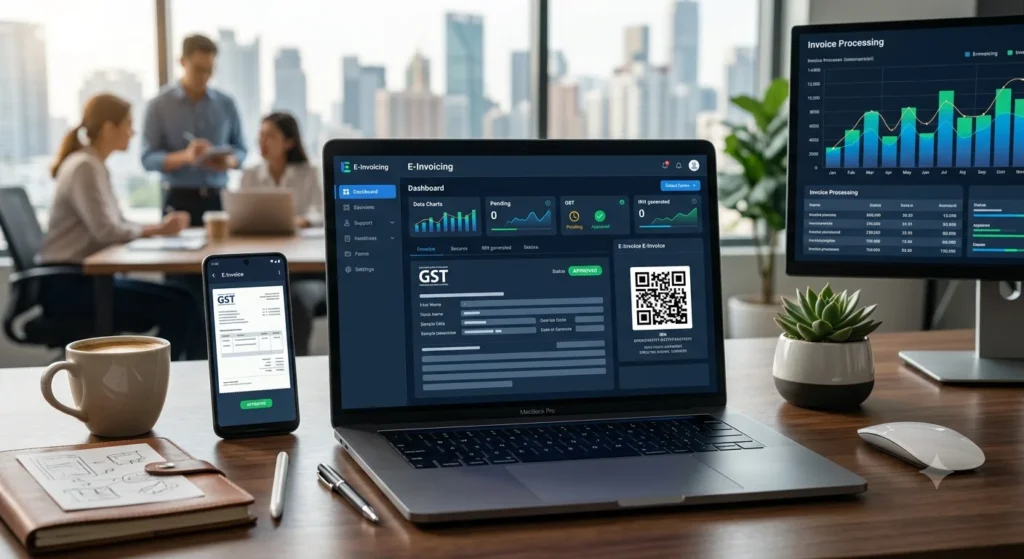
 
 
credit note e invoice

# E Tax Invoice: A Practical Guide to GST Digital Invoicing in India Businesses need a reliable way to record taxable supplies, maintain customer information and reconcile payments. An **e tax invoice** is part of India's GST digital reporting framework for specified transactions. It connects billing software with the Invoice Registration Portal (IRP), helping standardise invoice data. The business prepares the invoice in its own system; the portal authenticates the reported details. ## What Is an E Tax Invoice? An **e tax invoice** is a regular GST invoice whose prescribed details have been reported to an authorised IRP and successfully registered. After validation, the portal returns an Invoice Reference Number (IRN), acknowledgement details and a digitally signed QR code. The supplier shares the authenticated document with the buyer. The electronic tax invoice can then be matched with the seller's accounts and the buyer's purchase records. The system standardises invoice data but does not decide prices, goods, services or payment terms. The supplier remains responsible for customer details, taxable value and GST calculation. For a covered transaction, a valid IRN is essential. ## Who Must Follow E-Invoicing? The question **e invoice applicable to whom** is answered mainly by aggregate annual turnover, transaction type and notified exemptions. Under the general threshold, e-invoicing applies to registered persons whose aggregate turnover exceeds ₹5 crore in any preceding financial year from 2017–18 onwards, subject to applicable rules. Turnover is assessed across GST registrations linked to the same PAN, not separately for each branch. A business should not assume that **e invoice mandatory** requirements apply simply because its GST portal profile shows an enabled status. Enablement is a technical facility; legal applicability must be checked against the relevant notification. A business may also remain covered because it crossed the threshold in an earlier financial year. Specified categories are exempt under the notified provisions. These include certain banking and financial institutions, insurers, goods transport agencies providing covered road transport services, passenger transport service providers, multiplex cinema admission service providers and SEZ units. SEZ developers are treated differently from SEZ units. Since the exact exemption depends on the entity and service category, verify the current notification before deciding that **mandatory e invoicing** does not apply. ## Which Transactions Are Covered? The framework generally covers specified B2B supplies, exports, deemed exports, supplies involving SEZ developers and other notified transactions. It also covers GST credit notes and debit notes issued by a person required to report those documents under the rules. Therefore, **e invoice applicable** is not decided by turnover alone. A taxpayer must also check whether the particular document and transaction fall within the notified scope. Ordinary B2C sales are generally outside the IRN-based system. So, **e invoice applicable for b2c** is usually answered no for a standard B2C invoice, although separate dynamic QR code requirements can apply to specified large suppliers. A dynamic QR code should not be confused with reporting a B2C invoice to the IRP. Businesses should distinguish a tax invoice from a bill of supply, delivery challan, receipt voucher or commercial document. A commercial adjustment without GST implications is not automatically a reportable GST credit note. ## Credit Notes and Debit Notes A **credit note e invoice** is relevant when a supplier needs to reduce the taxable value or tax charged on an earlier supply, such as when goods are returned, a supply is deficient or an eligible price adjustment is made. The note should identify the original invoice and contain the prescribed particulars. It must also be reflected correctly in the supplier's records and returns. A debit note is used when the taxable value or tax charged on the original invoice was lower than the amount properly payable. A **debit note under e invoice** must be handled through the reporting process when the issuer is covered by the mandate and the document falls within scope. Businesses asking whether **e invoice applicable for debit note** should check the issuer's turnover, the GST nature of the note and the original transaction. GST credit and debit notes under Section 34 should not be confused with financial or commercial notes that do not adjust GST liability. Only documents meeting the relevant GST requirements should be treated as reportable. Correct original invoice references, dates, taxable values and tax amounts help both parties reconcile the adjustment. ## How the IRP Reporting Process Works A typical reporting workflow includes these steps: 1. **Prepare the invoice:** Create the sales document in billing, accounting or ERP software and verify supplier and recipient details. 2. **Validate the information:** Check GSTINs, document number, date, place of supply, HSN or SAC code, taxable value and tax calculation. 3. **Create the data file:** Convert the required details into the notified JSON format. 4. **Submit to an IRP:** Report through an authorised portal, integrated API, GST Suvidha Provider or supported offline facility. 5. **Receive authentication:** After validation, the IRP returns the IRN, acknowledgement details and digitally signed QR code. 6. **Share and reconcile:** Send the authenticated invoice to the buyer and review the related GST return records. The process supports data flow into the seller's GSTR-1 and relevant e-way bill functions, but businesses must still review books, file returns and reconcile records. An **e tax invoice** remains one part of wider GST compliance. ## Reporting Deadlines Businesses Should Track Taxpayers should report covered documents promptly rather than waiting until the end of a return period. From 1 April 2025, taxpayers with aggregate annual turnover of ₹10 crore or more are restricted from reporting invoices, credit notes and debit notes more than 30 days after the document date. IRP validation rejects submissions beyond this window. The published advisory states that this particular restriction does not apply to taxpayers below that AATO level as of now; other GST deadlines still apply. Assign responsibility for reporting, monitor documents awaiting IRN and alert staff before the deadline. This 30-day limit is separate from other GST time limits. ## E-Invoicing, GST and VAT Terminology Searches for **e invoicing tax**, **e invoicing vat** and **vat e invoicing** often come from businesses comparing digital tax systems across countries. In India, the domestic framework is GST e-invoicing. GST replaced most state VAT systems for many goods and services, while certain products and levies remain outside GST. VAT terminology may be relevant to another country's tax regime or a legacy accounting system, but India's GST rules should not be treated as identical to every VAT system. International businesses may need different invoice formats and tax identifiers in each jurisdiction. Configure billing software for the country and transaction instead of assuming one **electronic tax invoice** format meets every legal requirement. **Etax invoice** is an informal label; requirements depend on the tax system. ## What Does E-Invoicing Phase 2 Mean? The phrase **e invoicing phase 2** is often used to describe a later stage in the rollout of electronic invoicing. It is not a substitute for checking the current legal notification. India's GST e-invoicing system was introduced in stages, with the turnover threshold reduced over time. Businesses should focus on the threshold and transaction rules currently in force rather than rely on an old article describing an earlier implementation stage. The wider move towards **e invoicing compulsory** reporting has encouraged businesses to upgrade billing software, improve master data and establish clearer approval processes. Treat any future expansion or schema change as applicable only when supported by an official notification or GSTN advisory. A proposal, industry discussion or software announcement does not by itself create a legal obligation. ## Downloading and Maintaining Invoice Records To **download e tax invoice** copies, users should check the accounting or ERP system that created the document, the supplier's customer portal or the authorised IRP's available search and retrieval facilities. Keep the invoice data, IRN, acknowledgement number, signed QR code and supporting purchase or delivery records together. Download options can differ between software providers and portals. Maintain records by financial year and customer, keep invoice numbers searchable, track credit and debit notes separately, restrict editing access and back up files. Verify the IRN and document number before sharing a downloaded copy. ## Selecting Software and Strengthening Internal Controls Choose software that matches transaction volume and accounting workflows. Check schema support, IRP connectivity, bulk reporting, error messages, user permissions and exportable records. Test it with sample data and train staff to resolve errors. Useful controls include: - Keeping supplier and customer GSTIN master data current. - Using a unique document-number series for each financial year. - Checking HSN or SAC codes and tax rates before reporting. - Reviewing failed submissions daily. - Reconciling IRN records with sales registers and GST returns. - Distinguishing GST credit notes from commercial adjustments. These controls reduce mismatches. Review software updates when a schema or reporting rule changes. ## Final Considerations An **e tax invoice** is more than a digital copy of a paper bill. For covered taxpayers, it is a GST document that must be reported and authenticated through the prescribed system. Correct applicability checks, timely reporting, accurate tax data and organised records are essential for managing an **e tax invoice** process. Review whether each **e tax invoice** is supported by the right transaction records. Review official GST notifications and GSTN guidance when rules change, and consult a qualified tax professional for advice on a specific transaction or exemption. ADSONZ Business Studio helps businesses explore digital business solutions and technology options that support organised operations. For GST interpretation and filing decisions, businesses should rely on current government guidance and qualified tax advice.

What Are the E-Invoice Requirements Under GST?

Requirement

Description

Turnover limit

Aggregate annual turnover of ₹5 crore or more in any preceding financial year from 2017–18 onwards, subject to applicable notifications and exemptions.

Eligible transactions

B2B supplies, exports, SEZ supplies and specified other transactions.

Invoice registration

Report eligible invoices to an authorised IRP.

Invoice Reference Number

Obtain a unique IRN after successful validation.

QR code

Include the digitally signed QR code on the e-invoice.

Credit and debit notes

Report applicable GST credit notes and debit notes.

Invoice details

Maintain GSTIN, invoice number, date, HSN code, taxable value and GST details.

Record management

Retain invoice copies and supporting transaction records.

B2C transactions

Generally excluded from e-invoicing, although separate dynamic QR code requirements may apply to certain businesses.


Do I Need to File Taxes on My Side Gig Income?

Personal income is not taxable. However, side gig income from freelancing or business activities may be subject to Corporate Tax if annual business turnover exceeds AED 1 million.

What Should I Include on a Tax Invoice?

A tax invoice should include the supplier’s GSTIN, invoice number and date, customer details, product or service description, HSN/SAC code, taxable value, applicable GST rate, tax amount and total payable amount.

Can I Invoice Clients Without a Business Registration?

Yes, you can invoice clients without GST registration, but you cannot charge GST or issue a GST tax invoice. You may provide a regular commercial invoice, subject to applicable business and tax laws.

What Information Do Clients Need on an Invoice?

An invoice should include the client’s name, billing address, GSTIN (if registered), invoice number, date, product or service details, quantity, price, applicable taxes and total amount payable.

How to Generate Professional Invoices Quickly?

Use reliable invoicing software or accounting tools to enter client details, add product or service descriptions, calculate taxes, assign an invoice number and generate a PDF. Review the details before sending it to the client.

What's the Difference Between an Invoice and a Tax Invoice?

An invoice requests payment for goods or services, while a tax invoice includes required tax details such as GSTIN, taxable value and GST amount. A GST-registered supplier issues a tax invoice for applicable taxable supplies.

What's Required on an E-Invoice for Tax Purposes?

An e-invoice should include supplier and buyer details, GSTINs, invoice number and date, HSN/SAC codes, taxable value, GST rates and amounts. Applicable invoices must also contain an IRN and digitally signed QR code.

Leave a Reply

Your email address will not be published. Required fields are marked *

Comments

  1. ADSONZ Business Studio helped us understand the E Tax Invoice process and organise our digital invoicing requirements. Their guidance was clear and useful, making the setup easier for our business. I would recommend their service.